
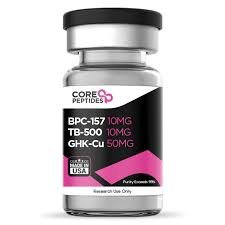
BPC-157, TB-500, and GHK-Cu Peptide Blend (70mg)
$280.00
Description
BPC-157, TB-500, and GHK-Cu Peptide Blend Production Description
The BPC-157, TB-500, and GHK-Cu peptide blend available from Cvspharmacyinc is a laboratory research formulation composed of three synthetic peptides widely examined in preclinical scientific literature. Each peptide has a distinct amino acid structure and has been studied for its role in cellular signaling, tissue response, and biological regulation in controlled experimental environments.
This blend brings together peptides researched across inflammation signaling, vascular response, collagen organization, and cellular movement. Scientific publications often examine these compounds independently. Combined exposure receives interest due to overlapping and complementary biological pathways described in laboratory studies.
BPC-157 Peptide Profile
BPC-157 stands for Body Protection Compound 157. It is a synthetic peptide consisting of fifteen amino acids. Research traces its sequence to a fragment associated with gastric proteins, although the precise native origin remains unidentified.
Laboratory studies link BPC-157 to intracellular signaling systems involved in tissue response. Research associates this peptide with endothelial stability, inflammatory signaling modulation, and cellular survival pathways. Experimental data describes its interaction with nitric oxide signaling systems, which play a role in vascular tone, blood flow regulation, and endothelial protection.
Studies in cellular and animal research models describe reduced inflammatory markers following exposure to BPC-157. Observed outcomes include lower infiltration of inflammatory cells and reduced production of inflammatory mediators such as leukotrienes and thromboxanes. Research also describes increased macrophage activity linked to resolution of inflammation rather than prolonged inflammatory signaling.
BPC-157 research further connects the peptide to growth response signaling. Studies report upregulation of early growth response genes and activation of focal adhesion related signaling pathways, including FAK and paxillin. These pathways support cell attachment, migration, and organization within the extracellular matrix.
Research also describes increased collagen presence and blood vessel density in experimental injury models. These findings support interest in BPC-157 within tissue response and structural repair research contexts.
TB-500 Peptide Profile
TB-500 is the synthetic equivalent of thymosin beta-4, a naturally occurring peptide encoded by the TMSB4X gene. TB-500 consists of forty three amino acids and is studied extensively for its influence on cellular movement and cytoskeletal dynamics.
Scientific literature links TB-500 to actin regulation inside cells. The peptide binds globular actin and influences actin filament assembly. This activity supports coordinated cell movement, shape change, and migration across tissue matrices.
Research associates TB-500 with angiogenic signaling pathways. Laboratory models describe increased expression of vascular growth factors such as VEGF-A, angiopoietin-2, and Tie2 receptors following peptide exposure. These factors play central roles in new vessel formation and endothelial organization.
TB-500 studies also highlight regulatory activity within inflammatory signaling pathways. Research reports increased microRNA-146a expression following exposure. MicroRNA-146a acts as a regulator of Toll-like receptor signaling by suppressing IRAK1 and TRAF6 activity. Reduced activity in these proteins limits downstream NF-kappaB signaling, a central driver of inflammatory gene expression.
Additional experimental studies describe improved wound surface regeneration and structural organization in tissue models exposed to TB-500. These outcomes support interest in the peptide within research focused on tissue coordination and repair mechanisms.
GHK-Cu Peptide Profile
GHK-Cu is a copper bound peptide complex composed of the tripeptide sequence glycine, histidine, and lysine linked to a divalent copper ion. Research identifies GHK sequences as naturally released during tissue breakdown and collagen degradation.
Scientific studies associate GHK-Cu with cellular repair signaling. Research describes interactions with enzymes, ion channels, and cell surface receptors. These interactions influence gene expression linked to collagen synthesis, antioxidant response, and inflammatory regulation.
Copper plays a central role in the biological activity of GHK-Cu. Copper acts as a cofactor for enzymes involved in tissue repair and vascular growth. The peptide complex delivers copper in a biologically active form within research environments.
Laboratory studies link GHK-Cu to reduced oxidative stress in activated immune cells. Research describes lower reactive oxygen species levels and restoration of antioxidant enzyme activity. These outcomes correspond with reduced inflammatory mediator release in experimental models.
GHK-Cu research also associates the peptide with increased expression of vascular growth factors and endothelial cell proliferation. These activities align with angiogenic response pathways described in controlled studies.
Combined Peptide Research Perspective
Scientific literature often examines BPC-157, TB-500, and GHK-Cu independently. Each peptide influences different aspects of cellular behavior. Combined exposure draws attention due to overlapping pathways involving inflammation regulation, vascular signaling, collagen organization, and cell migration.
BPC-157 research emphasizes endothelial protection, inflammatory moderation, and extracellular matrix signaling. TB-500 research focuses on cytoskeletal organization, cell movement, and angiogenic signaling. GHK-Cu research highlights copper mediated repair signaling, antioxidant activity, and collagen synthesis.
Together, these pathways align across multiple stages of cellular response. Inflammatory regulation supports a stable environment. Angiogenic signaling improves nutrient and oxygen delivery. Cytoskeletal coordination supports cell migration. Collagen synthesis supports structural integrity.
Anti Inflammatory Research Summary
Studies link all three peptides to reduced inflammatory signaling in laboratory models. TB-500 research demonstrates suppression of Toll-like receptor mediated pathways through microRNA regulation. BPC-157 research reports reduced inflammatory cell infiltration and normalization of biochemical markers associated with inflammation. GHK-Cu research describes reduced cytokine release and oxidative stress in immune activated cell cultures.
Importantly, these effects appear regulatory rather than immunosuppressive in research settings. Studies describe modulation of signaling intensity rather than complete pathway shutdown. This distinction supports interest in controlled cellular balance research.
Angiogenesis and Vascular Research Summary
Angiogenic response represents a shared research theme across all three peptides. TB-500 research describes enhanced endothelial migration and tube formation. BPC-157 research associates the peptide with endothelial survival and vessel patency. GHK-Cu research highlights copper dependent growth factor activation and endothelial proliferation.
These pathways support new vessel formation in experimental injury models. Improved vascular response supports nutrient delivery and waste removal, both essential factors in tissue organization research.
Collagen and Structural Research Summary
Collagen organization receives attention across peptide research literature. TB-500 studies describe improved collagen alignment and fibril diameter in ligament and tendon research models. BPC-157 studies report accelerated fibroblast movement and survival under oxidative stress. GHK-Cu studies associate the peptide with increased collagen synthesis and improved tendon to bone integration in laboratory environments.
These findings support research interest in structural matrix response and connective tissue organization.
Chemical Composition Overview
BPC-157
Molecular formula C62H98N16O22
Molecular weight 1419.5 g per mol
Alternate name Body Protection Compound 157
TB-500
Molecular formula C212H350N56O78S
Molecular weight 4963 g per mol
Alternate name Synthetic Thymosin Beta-4
GHK-Cu
Molecular formula C14H23CuN6O4
Molecular weight 401.9 g per mol
Alternate name Glycyl L histidyl L lysine copper two plus
Research Use Statement
The BPC-157, TB-500, and GHK-Cu peptide blend from Cvspharmacyinc is supplied strictly for laboratory research and educational analysis. Scientific findings referenced originate from in vitro and preclinical research environments. Regulatory approval for human or veterinary use does not apply.
Cvspharmacyinc positions this peptide blend within a research focused framework, supporting academic review, experimental design, and scientific discussion.
Related products
-
- peptides
BPC-157 and TB-500 Peptide Blend
- Price range: $105.00 through $190.00
- Select options This product has multiple variants. The options may be chosen on the product page
Reviews
There are no reviews yet.